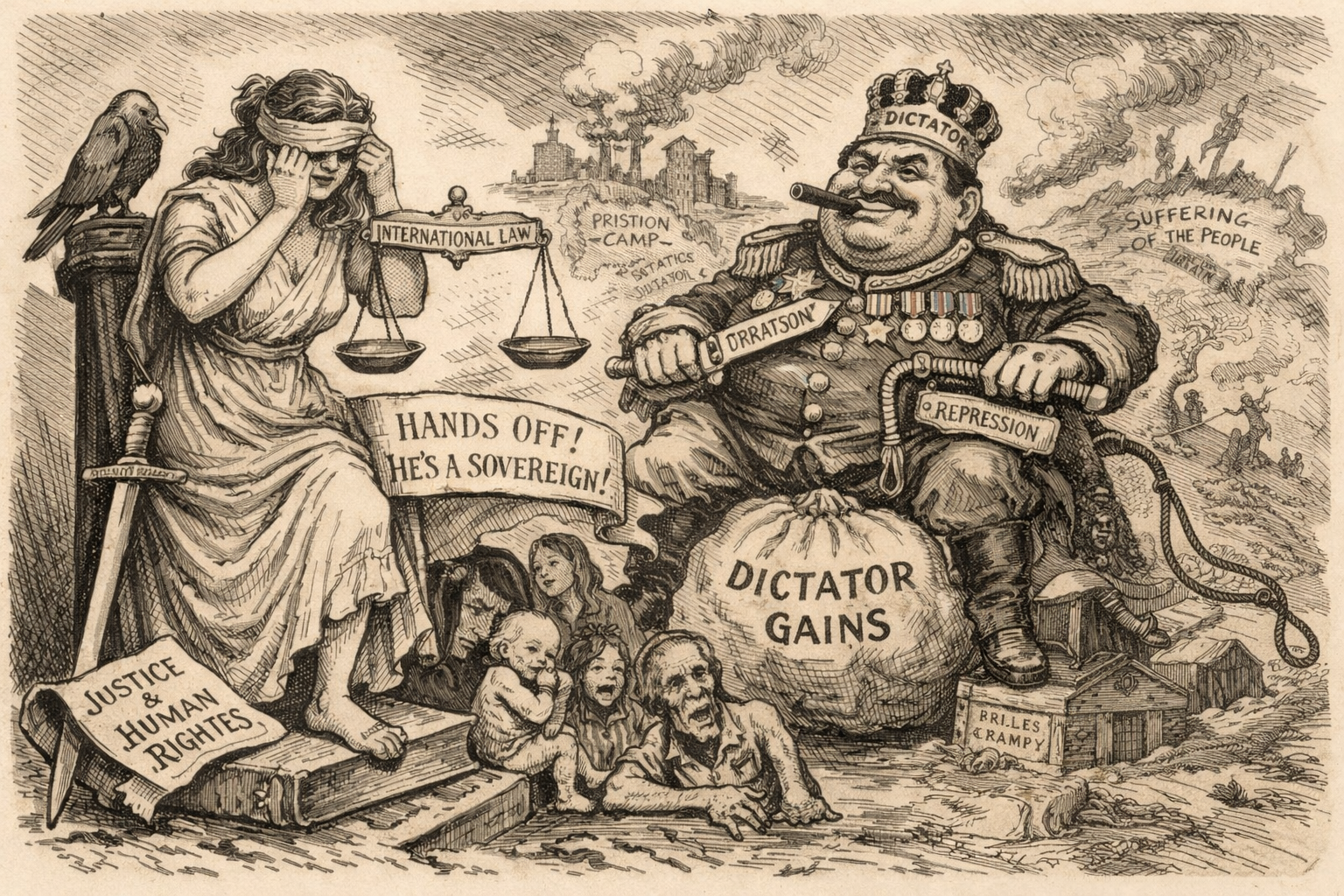
There are moments when public debate exposes less about the event itself than about the intellectual reflexes of those reacting to it. In such moments, the language of outrage and legality rushes in to fill the void left by moral hesitation, offering the comfort of rules precisely when judgment would demand something harder and more unsettling.
The recent United States seizure of Nicolás Maduro from Caracas, carried out in defiance of Venezuelan sovereignty and almost certainly in breach of international law, has produced a situation in which reflexive legal condemnation has raced ahead of any serious reckoning with the moral conditions that gave rise to the act itself. Within hours, the discussion narrowed to a familiar catechism. Which provisions of the UN Charter were violated? Which precedents were undermined? Which norms had been trampled? The circumstances that prompted the action, a state hollowed out by kleptocracy, repression and mass flight, were treated as secondary or impolite. Condemnation came swiftly and comfortably, as though the matter could be settled by citation alone. This reveals a deeply ingrained assumption that legality and morality naturally coincide, that an action deemed unlawful must therefore be wrong. History, from the sanctified injustices of apartheid to the impeccably legal brutalities of colonial rule, offers scant support for so soothing a belief.
International law, like all law, is a human construction. It is not handed down from Sinai but negotiated by states, often with profoundly divergent interests and moral standards. Its postwar architecture was shaped by the understandable desire to prevent aggressive war and unchecked imperialism. Yet over time it has acquired a secondary function which is far less admirable. It has become a shelter for regimes that brutalise their own citizens while invoking sovereignty as a talisman against accountability. The principle that borders are inviolable has, in practice, meant that mass repression behind those borders is treated as an internal matter, regrettable perhaps but legally insulated.
This is where the moral tension begins. A law that exists primarily to restrain the strong can, in certain circumstances, entrench the power of the cruel. Venezuela under Nicolás Maduro has for years been a case study in this inversion. A state that systematically dismantled democratic institutions, criminalised dissent, hollowed out the economy and presided over mass emigration was nonetheless treated as legally equivalent to any other sovereign member of the international community. The victims of that system had no comparable protection. International law did not intervene on their behalf. It merely observed.
It was precisely this contradiction that Martin Luther King Jr addressed in his “Letter from Birmingham Jail” when he wrote, “One has not only a legal but a moral responsibility to obey just laws. Conversely, one has a moral responsibility to disobey unjust laws.” King was not advocating anarchy. He was articulating a hierarchy in which law derives legitimacy from justice rather than the other way around. A similar sentiment is often paraphrased as the idea that if a law is immoral, then it is your moral obligation to break it. This tradition runs from Augustine to Aquinas and on through the civil rights movement. It insists that legality without morality is an empty shell.
The uncomfortable question, then, is whether international law has reached a point where it functions as an alibi for moral paralysis. When every response to atrocity is met with the same incantation about norms and procedures, something vital has been lost. It is not that law should be discarded lightly. It is that law should not be fetishised to the point where it excuses indifference. A rule that effectively guarantees impunity to rulers who deny their citizens basic freedoms is not morally neutral. It is morally implicated.
This does not lead to a simple endorsement of unilateral force. The world is littered with disastrous interventions justified in the language of righteousness. Iraq stands as a warning against the intoxication of moral certainty untempered by prudence. The removal of a tyrant does not guarantee the emergence of a just society. Venezuela may yet lurch from one form of dysfunction to another. Scepticism is not only warranted but necessary. Moral seriousness demands an awareness of unintended consequences and historical precedent.
Complicating matters further is the identity of the actor. Donald Trump is, by any reasonable ethical measure, a deeply flawed and often irresponsible figure. He debased democratic norms, trafficked in falsehoods and exhibited a striking indifference to truth. Yet it is intellectually dishonest to argue that immoral people are incapable of moral outcomes. Complicating matters even further still is the fact that the Trump administration almost certainly cares less about the plights of the Venezuelan people and more about the strategic gains in oil and rare earth minerals. History is crowded with examples of compromised individuals performing consequential acts for mixed motives. To refuse to acknowledge this is to collapse moral reasoning into personal animus. Disgust at a person is not an argument against the effects of a particular action.
The harder work lies in holding several truths at once. That international law matters and that it is imperfect. That sovereignty can be both a shield against aggression and a weapon against accountability. That breaking the law can be reckless and that, in rare cases, it can expose the law’s own corruption. The world is not improved by ritual denunciations that require no thought beyond citation. It is improved by the willingness to ask whether the rules we defend still serve the ends they were meant to protect.
If international law is to retain moral authority, it cannot operate as a private members’ club for governments alone. It must be tethered, however imperfectly, to the condition of the people who live under those governments. A legal order that treats a dictatorship and a democracy as morally interchangeable has already surrendered its ethical core. To point this out is not to celebrate force or abandon restraint. It is to insist that law exists for human beings, not for their jailers.
It may therefore be worth asking whether it is truly inconceivable to imagine an international order in which the protections of international law are not granted automatically and unconditionally, but are contingent upon a state’s own adherence to the most basic standards of human rights and civic freedom. A legal system that extends its full shelter to regimes that imprison opponents, starve populations and rule by fear is not morally neutral. It has already made a choice, and not a defensible one.