Few countries hold such a natural geopolitical position of power as Turkey. Situated in the northeastern Mediterranean and straddling the Bosporus, it is the guardian for all trade from the Black Sea and the gateway between Europe and the Middle East.
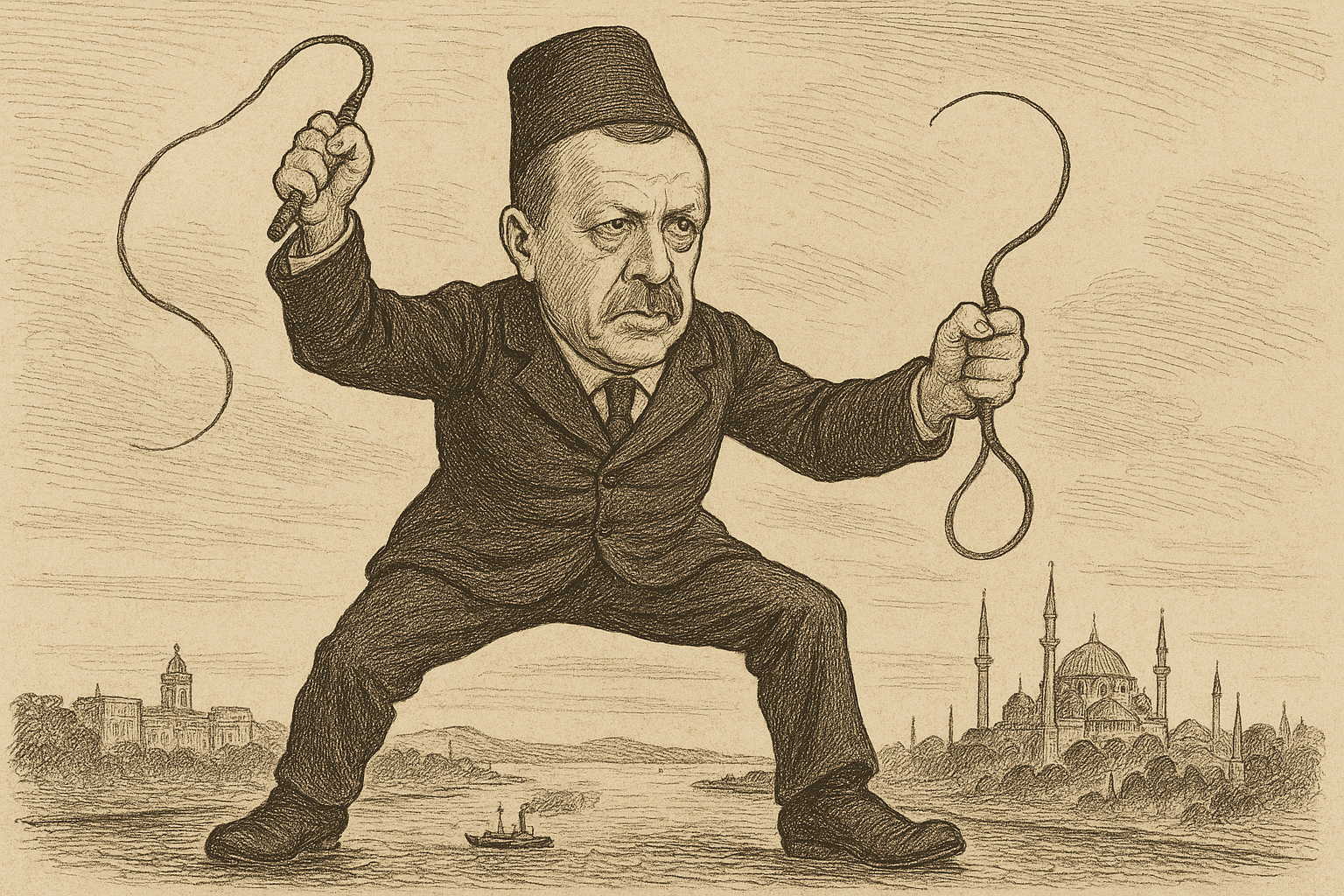
Once lauded as a paragon of “moderate Islam” and democratic aspiration, it has now adroitly transformed itself into a regional power whose ambitions stretch far beyond the dusty battlegrounds of Kurdish enclaves or the diplomatic corridors of NATO headquarters. Ever since Recep Tayyip Erdoğan came to power in 2003, the authoritarian fist has clenched ever tighter, and the country has slipped downward on indexes measuring democratic rights and freedom of the press on an almost yearly basis. Press freedom in Turkey is now virtually non-existent, and the authorities are openly going after foreign journalists. The British reporter Mark Lowen was arrested and deported when trying to cover the protest in Istanbul in March 2025. As of writing this, the Swedish journalist Joakim Medin sits in a maximum-security prison accused of the Orwellian crime of “insulting the president”.
The same goes for political rivals. Ekrem İmamoğlu, the popular mayor of Istanbul and a key opposition figure, was sentenced to over two years in prison for the absurd charge of insulting public officials. His real crime, of course, was winning the mayoralty in 2019 and proving that Erdoğan’s grip on urban Turkey was not invincible. The persecution of İmamoğlu reveals a regime terrified not only of dissent but of electoral defeat—a cardinal sin in any modern autocracy.
Yet somehow, modern diplomacy has, like it often does, rewarded this burgeoning autocracy for its very intransigence. Erdoğan’s strategic patience and cynical realpolitik have brought it a power not wielded since the long twilight of the Sublime Porte. And internationally, he has played his cards with Machiavellian finesse. Turkeys involvement in Syria was not driven by humanitarian concerns or democratic sympathy but by imperial calculus. Bashar al-Assad, once a convenient neighbour, had become a liability; his fall, and the consequent dissolution of his regime, came by way of Turkish design. And Ankara got what it wanted. Assad’s government collapsed, and Damascus fell under the control of Ahmed al-Sharaa, a former rebel leader with close ties to Ankara. This outcome is perhaps Ankara’s greatest strategic victory in decades. Turkey’s sponsorship of Syrian rebels was not peripheral but instrumental. From 2011 onwards, Turkish intelligence facilitated the transfer of weapons, fighters, and funding to various opposition groups, ranging from the moderate to the plainly extremist. The Free Syrian Army was, in many respects, a Turkish creation, armed and trained within its borders. Turkish territory became the rear base of the rebellion. Ankara’s military operations—Euphrates Shield, Olive Branch, and Peace Spring—further carved out de facto Turkish zones in northern Syria, acting as buffers against both the former Assad regime and the Kurds.
Next on Erdoğan’s wishlist was the Kurdish question. The negotiated thaw with the PKK, much like its posture toward Armenia, Greece, and Cyprus, oscillates between threat and conciliation in accordance with Ankara’s convenience. This February, Abdullah Öcalan—the PKK’s imprisoned leader and long-time bête noire of the Turkish state—called for a ceasefire and urged the PKK to disband—a gesture that signalled Ankara’s ability to manipulate even its most entrenched adversaries when expedient. A deal was probably made somewhere, but the details of such an agreement are not public knowledge.
All this goes to show that there are no permanent friends or enemies in Erdoğan’s court—only permanent interest. This should surprise no one. One might recall that Atatürk, no democrat himself, abolished the caliphate in 1924 not out of modernist whimsy but because he understood that religious governance was anathema to the rational state. Erdoğan, conversely, has all but resurrected the caliphate in spirit, if not in name.
Turkey today finds itself stronger on the world stage than at any point since the armistice of Mudros. Its veto power within NATO has become a lever with which to extract concessions from the West, from fighter jet sales to the silencing of Kurdish exiles. In Libya, in the Caucasus, and in the Horn of Africa, Turkish drones now define the balance of power, while Turkish diplomats exploit every crack in the crumbling post-Cold War consensus. It is, in fact, hard to escape the conclusion that Turkey has now acquired virtually everything it set out to achieve: a fractured Syria, a marginalised Kurdish movement, dominance over rebel factions, and a pliant NATO. No longer on the back foot, it stands poised, seeking new domains for influence. A power that has completed its immediate agenda often becomes most dangerous—not from desperation, but from appetite.
By the vestiges of historical power and modern autocratic manipulation, Turkey now stands as the regional hegemon, and Erdoğan fashions himself as a power broker and kingmaker for the entire Middle East (and beyond). The big question lies in where its interests will align. The might of the Turkish army could very well become a counterweight to Putin’s Russia on the other side of the Black Sea. At the same time, the country is no longer considered a democracy and is on the road to full dictatorship. As Erdoğan now has won every battle he chose to fight, the only enemy left may be his own success—and the empty throne of empire he now occupies alone.