Photo: JL
Originally written in April 2024
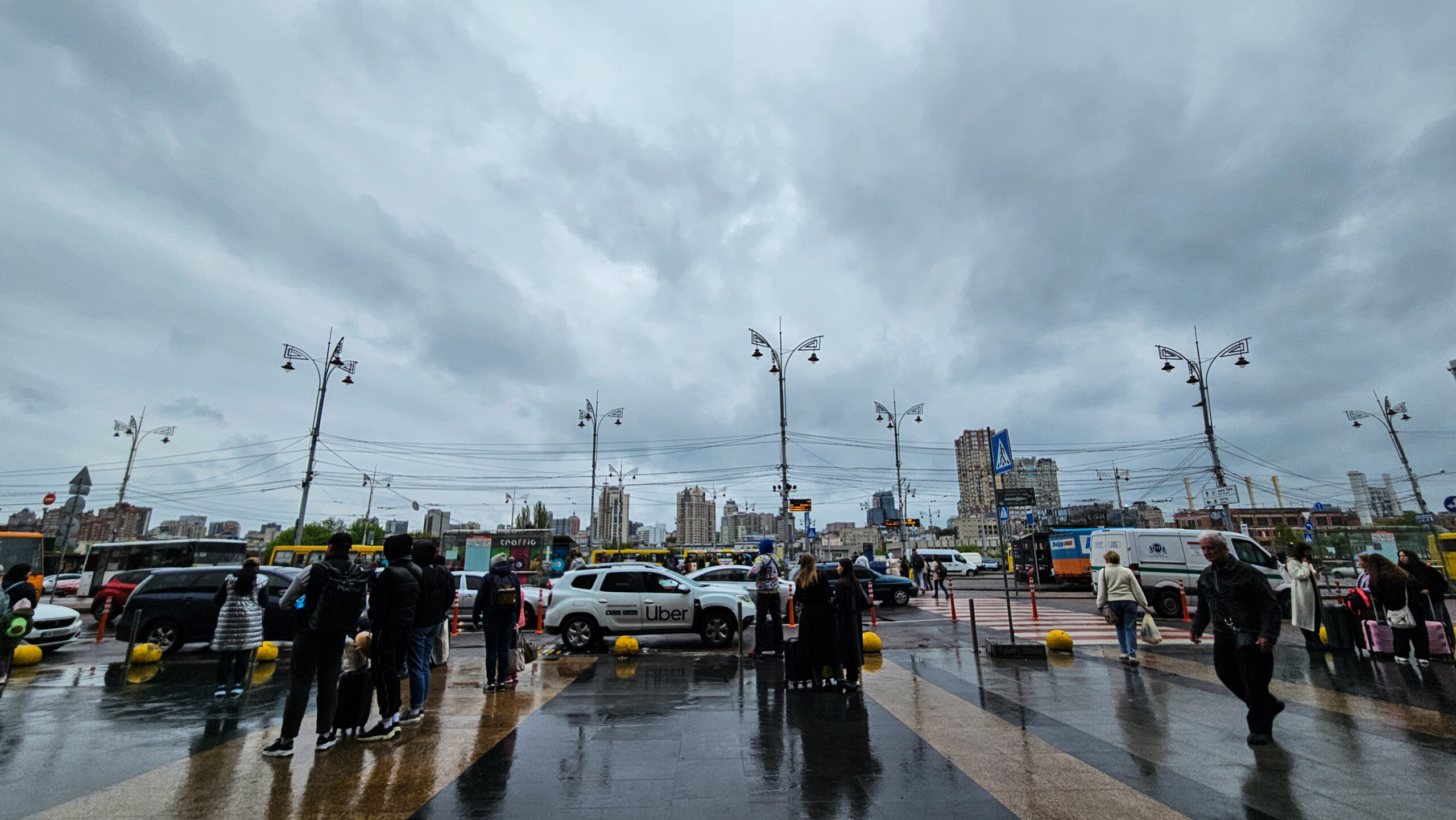
The strangest thing about arriving in Kyiv is how normal everything is. The train from Warsaw arrived exactly on time. Hours before, the city of Chernihiv, located two hours north of Kyiv, was hit by a Russian missile strike, killing 18 people and injuring 78. Yet life outside the train station goes on as usual, and the city is full of afternoon activity. Taxis are lined up outside the main entrance. Across the street is a McDonald’s. On the way into Kyiv, the train passed Irpin, where the Russian column meant to take the Ukrainian capital was finally stopped and forced back in March 2022. Today is a Thursday in mid-April 2024, and the rain falls lightly and steadily over the city.
In recent months, Russian troops have advanced on the battlefield, pushing back the Ukrainian forces, who are at a disadvantage and, above all, lack the same capacity and access to ammunition. According to several reports, Ukrainians can fire one artillery shell for every ten fired by the Russians. Despite this, there is no sign that the Ukrainian resolve is weakening. According to a survey commissioned by the Munich Security Conference in 2023, 89% of Ukraine’s population believes the country should continue fighting even if Russia resorts to nuclear weapons.
On the train to Kyiv, I met a professor of political science at one of the universities in Kyiv, whose name will be left out for privacy reasons. He was on his way home from a human rights conference in Warsaw. When first asked about the war, he answered that there is no future in which Ukraine cedes territory to Russia to make peace. “We’ve given up too much to back down now. We will continue until there are no Russian troops left on Ukrainian soil.” But when I later asked how he thinks it will end, he fell silent for a long moment before saying with a sorrowful sigh, “I really don’t know.” His mentality mirrors much of the sentiment of the country: proud defiance in the face of monumental uncertainty.
The first impression of the city is that it looks just as it did before the Russian invasion began. Then, you see a collapsed building by the side of the road, and it’s hard to tell if it’s the kind of decay common in the former Soviet Union or the kind caused by artillery. The roof and part of the exterior wall have caved in, and all the windows are missing. It is one of several dilapidated buildings in the city. Some of them even have full-grown trees inside, with branches stretching out through the openings where glass panes once were. It serves as a reminder that not all collapsing buildings are damaged by war. Somehow, this only makes the city more beautiful. For it is a beautiful city in its own way. The city centre is teeming with ornate buildings from the last century and wide cobblestone boulevards. On the outskirts, the cityscape shifts to a Soviet grey. Central Kyiv has more in common with Paris or Barcelona than with many other European cities that we more easily associate with Europe based on their geographical location. It is in many ways an architectural memory of Russian imperialism’s desire to be part of continental Europe and the stalinist concreete a reminder of why this is not the case. At least not yet.
At the heart of the city is Maidan, which literally means ”square.” This is where the Ukrainian revolution began over ten years ago and set in motion the long chain of events where seeking freedom was punished by war. At one end of the square, thousands of small Ukrainian flags are planted in the flowerbeds, and hundreds of photographs of fallen soldiers border the flowers. Some of them are pictured as soldiers in full gear. Others look like profile pictures of fathers and cousins in plaid shirts and awkward smiles. It is mostly former civilians who die in this war. They are friends, accountants, and school teachers called to the front by honour of necessity, whose children will grow up with the memory of a hero instead of a parent. According to Ukrainian sources from February 2024, 31,000 Ukrainian soldiers have died on the battlefield.
The granite slabs covering Maidan are cracked and shift when you walk across the square. On a rainy day, like today, rainwater gathers in the cracks and almost lifts the granite from the foundation as they wobble. In the pedestrian tunnels leading to the square, water drips from the ceiling. The Independence Monument, however, still shines golden even under heavy clouds. The luxurious TSUM department store remains open, but customers are few, and the staff stand at their stations, politely greeting with bored smiles. In the men’s department, visitors are met with military clothing and camouflage gear. On the other side of the square, military roadblocks are gathered. They are no longer deployed on the parade street but remain close at hand. Further up the street, however, there is a military checkpoint. One of many in the city.
In a bar on the other side of town, a bartender offers his perspective on the normality that seems to surround the city. It is still early, yet the bar is already filling up, and several tables are reserved. Bars in Kyiv are open until 11 p.m. so guests can get home in time for the nightly curfew, which starts at midnight. “The normality is an illusion,” he begins, then searches for the right words to explain. “We have shelters in our basements and shelters in our minds. It’s frightening with everything that’s happening, but you have to block it out. Otherwise, you can’t function.” He is 30 years old and grew up in Kyiv. “I am scared, but I want to stay. This is my hometown. Besides that, I don’t have the 8,000–10,000 USD needed to bribe my way out of the country. There are ways out created by corruption, but I don’t have that kind of money.” He continues, mixing a new drink as he speaks. “I would go to the front if I were called up,” he explains, his voice somewhat uncertain. “When I did my military service 12 years ago, our military was very poor, and our weapons were broken. Today our military is very strong.”
The following day, spring arrived in Kyiv. The streets were filled with people, and there were long queues at coffee stands and ice cream parlours along the boulevard. Then, suddenly, air raid sirens bellowed across the city. The sound is like a slowly undulating lament. But nobody reacted. No panic broke out. Some turned their heads, but no one even quickened their pace. Others look down at their phones. There are apps and Telegram channels with detailed information about everything the Russian army is doing. Then the alarm fell silent again, and life continued.
On 20 April, the United States Congress voted for the proposal for new support for Ukraine, and across Kyiv, a collective sigh of relief was felt. People gathered in groups around their phones, and for many, it was as if hope had returned.
On the trains to Kyiv, most of the passengers were men. On the train from Kyiv, it is almost exclusively women. Under the current state of martial law, men between the ages of 18 and 60 are not allowed to leave the country. On the train towards Warsaw sits Tatiana. She is 66 years old and comes from Kharkiv, one of the cities hardest hit by the war. She is on her way to Valencia to help her daughter take care of her grandson until he can start nursery. Her grandchild was born in January 2022, and when Russia attacked, Tatiana’s daughter fled to Spain with her newborn child. Tatiana’s husband remains in Kharkiv. Many of her friends have lost their homes in the Russian artillery attacks, but her home is still standing. “I am often afraid when I read the news from Spain about what is happening back home in Ukraine. When I am home, it doesn’t feel as dangerous. At least then, I am at home,” she explains.