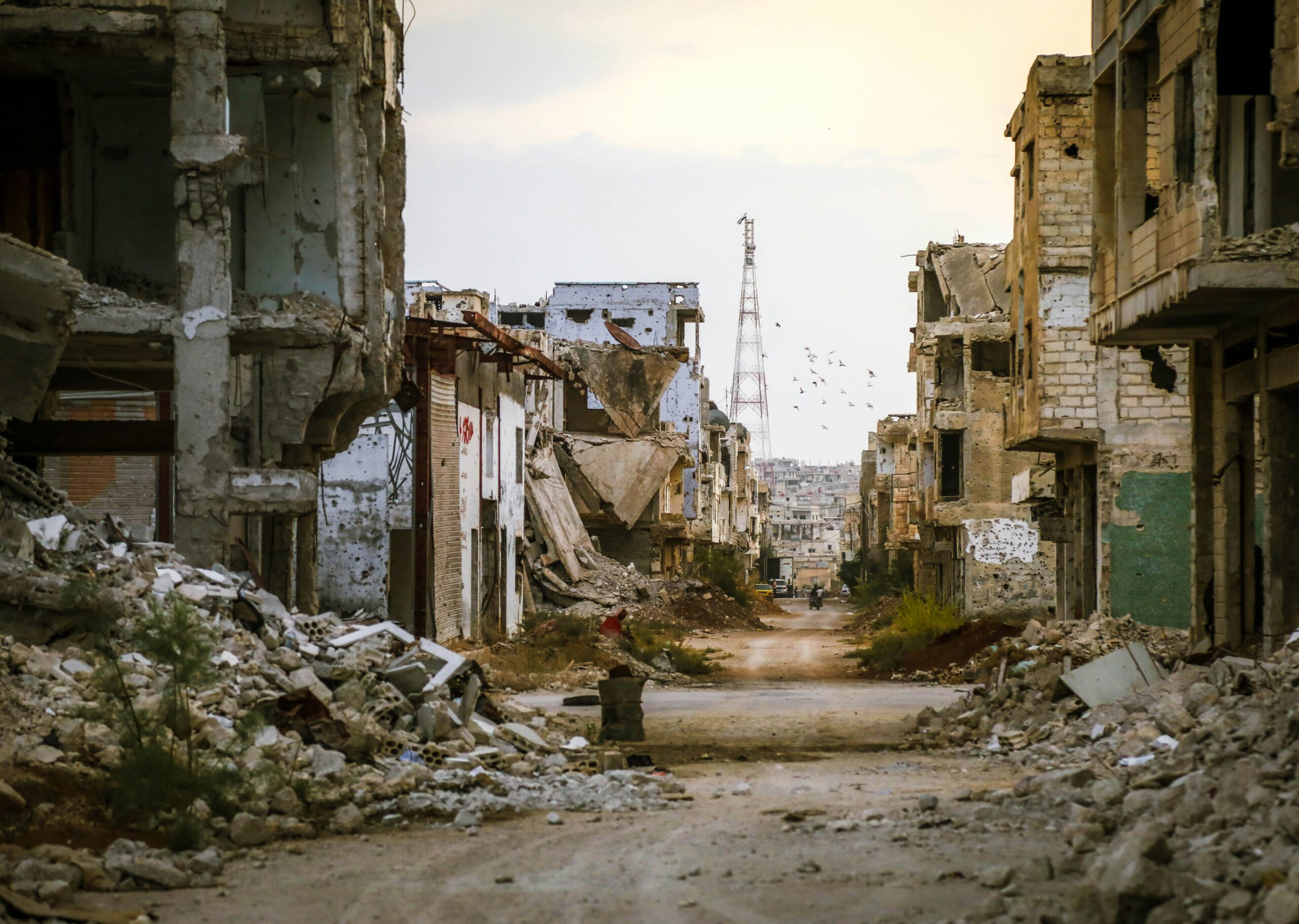
Photo: Mahmoud Sulaiman
The dust of Syria’s revolution had barely settled when the country’s new leader, Ahmed al-Sharaa (previously known under the nom de guerre Abu Mohammed al-Golani), addressed the nation from the Umayyad Mosque in Damascus. He promised that Syria would become a nation where minorities are included and respected within its borders. Two days later, the parliament was dissolved, and a transitional government is now set to lead the country and review the constitution.
For those who observed the Arab Spring with naive hope for a new dawn in the Middle East, Syria long stood as a tragic epitaph for these dreams. Across much of Europe and North America, the uprisings were portrayed as an Arab version of 1989—a march toward liberal democracy that would dismantle the oppressive regimes of the Middle East. But this romantic vision obscured an uncomfortable truth, and if there is one lesson to be drawn from history—from the revolutions in Iran, Afghanistan, and Libya—it is that revolutions are rarely the architects of freedom.
It is tempting to see Syria’s suffering as a tragedy of unique scale and circumstance. Which, indeed, it is for the hundreds of thousands who have lost their lives in the civil war. At the same time, we can achieve a greater understanding if we look at it as part of a larger historical pattern. Revolutions—from Tehran to Tripoli—share the trait of being easier to ignite than to control, and the West, in its eagerness to cheer the fall of dictators, consistently fails to foresee the hydra heads that grow from their ruins.
Think of Iran in 1979. The revolution swept away the Shah’s regime only to install one whose theocratic rigidity was alien not only to its sponsors but also to the revolutionaries themselves. Afghanistan offers an even darker vision of the future. The Saur Revolution of 1978 and the subsequent chaos led to the Soviet invasion, and the U.S.-backed mujahideen paved the way for decades of war, Taliban rule, and subsequent American occupation. When the Taliban finally regained power in 2021, forcing the American military into a humiliating withdrawal, spokespersons promised that a new, softer order awaited. Beautiful words that soon proved short-lived. Today, women in Afghanistan are forbidden to speak in public and, according to the law, must even speak with a hushed voice in their own homes.
The West’s gravest misconception lies in its view of revolutions as binary struggles: the people versus the regime. This narrative, more headline-friendly than truthful, fundamentally fails to grasp the complexity of societies fractured by sectarianism, religion, tribal loyalties, and historical grievances. In Libya, Muammar Gaddafi’s overthrow was celebrated as a victory for freedom, but in the ensuing power vacuum, the nation transformed into a failed state that, 14 years after Gaddafi’s death, has yet to rise from the ashes and remains a springboard for the refugee tragedy unfolding in the Mediterranean.
For those inclined toward optimism, the Arab Spring once promised a modern transformation of the region. In practice, it more closely resembled the French Revolution’s tendency to consume its own. The fact that the Assad regime has been firmly swept aside, must, despite all this, be seen as a victory for the Syrian people. But the rebels who are now set to replace him—Hayat Tahrir al-Sham (HTS), the Free Syrian Army, the Kurdish YPG, and Islamist factions like Jabhat al-Nusra and ISIS—have long been at war not only with the regime but also with one another.
Syria’s future, therefore, hangs by a thread. If there is a way forward, it lies not in Western fantasies of yesteryear, but in the slow work of reconciliation, institution-building, and reckoning with history. At the same time, history provides a brutal reminder: for Syria to become one of the few exceptions, it will take far more than beautiful words.