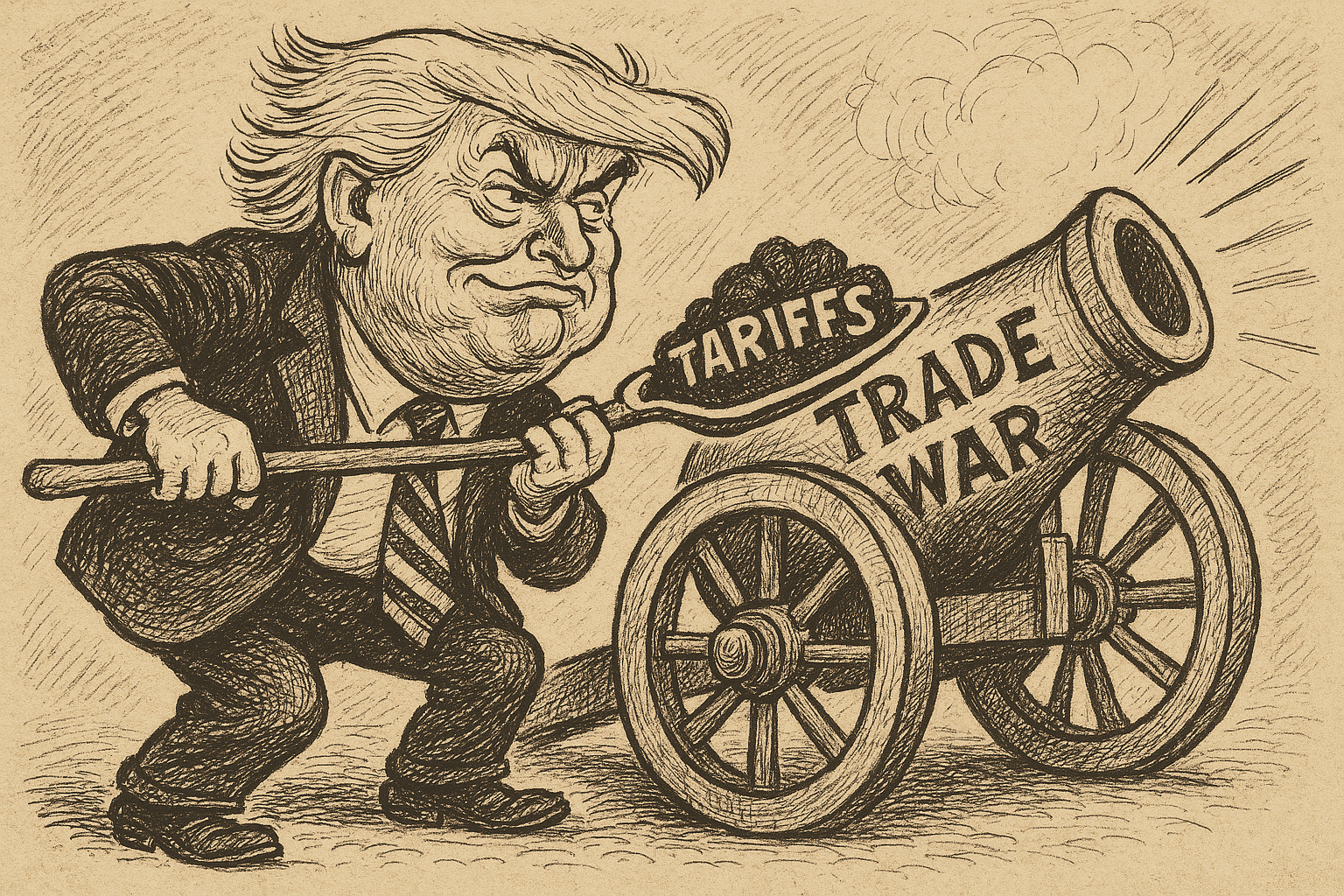
Few adages are as worn out as ”those who cannot remember the past are condemned to repeat it.” Yet, for all its clarity and fame, it seems like the lesson never really sticks in the minds of those who would benefit the most from it. The words, originally coined by Spanish-American philosopher George Santayana in the early 20th century, now echo with particular force when examining Donald Trump’s trade policy – a tariff war that appears to have emerged from the same collective American amnesia that runs through the rest of the White House at the moment.
Trump enthusiastically embraced tariffs as an economic tool during his first presidential term, stating on Twitter in March 2018 that ”trade wars are good and easy to win.” Boasting a confidence that should give even the most devoted mercantilists pause.
This protectionist quiver draws inevitable parallels to two other notorious periods in American history: the introduction of the ”Tariff of Abominations” in 1828 and the Smoot-Hawley Act of 1930. So, let’s take a look at what history has to say about American tariffs.
In 1828, President John Quincy Adams signed one of the most controversial tariff laws in American history. This draconian measure, formally known as the ”Tariff of 1828” but soon renamed the ”Tariff of Abominations” by its opponents, imposed duties of up to 62% on imported goods. As historian Arthur Schlesinger Jr. describes in ”The Age of Jackson” (1945): ”The ruthlessly protectionist act of 1828 aroused a fury in the cotton-growing states of the South never before witnessed in the history of the union.” It was a law designed to protect the interests of northern industry but at the expense of the South’s agricultural economy – a rift that only widened until it eventually contributed to the Civil War.
One hundred years later, it was time again. This time Herbert Hoover signed the Smoot-Hawley Tariff Act of 1930, a law that raised tariffs to historically high levels on over 20,000 imported goods. The law triggered a spiral of international retaliatory measures that deepened the Great Depression and led to a significant decline in global trade between 1929 and 1934.
Moving swiftly along to this century, Trump’s tariff war, both during his first presidency and now again after his reinstatement, exhibits striking similarities to these historical mistakes. Just as the 1828 tariff aroused regional hostility, Trump’s punitive tariffs against China, Europe, Mexico, Canada, and other trading partners have provoked retaliatory measures. And just as the Smoot-Hawley Act of 1930 ignored experts’ warnings, Trump has dismissed the unanimous criticism of today’s economists. But there is a fundamental difference between then and now – today’s global value chains are infinitely more complex and intertwined than during previous protectionist experiments.
So, what lessons can history teach us about the future of this modern tariff war? The first one is that protectionism recurs periodically, driven by nationalism, economic anxiety, and political opportunism. History, however, also offers a hopeful perspective. After the Smoot-Hawley catastrophe, US trade policy under the leadership of Cordell Hull shifted towards reciprocal tariff reductions through the Reciprocal Trade Agreements Act of 1934. After World War II, the US led the construction of a rules-based trading system through GATT, later the WTO. Perhaps the most apt historical parallel is not how trade wars begin but how they end – with a renewed recognition of the mutual benefits of free trade.
This is perhaps the central challenge for international trade policy after Trump. The historical lessons from 1828 and 1930 are clear: protectionism may provide short-term political satisfaction but leads to long-term economic stagnation and international tensions. History gives us clear testimony that trade barriers, however politically appealing they may be in the moment, ultimately harm the very workers and industries they claim to protect. When the inevitable effects of higher prices, reduced exports, and economic stagnation are felt throughout American society, we can expect the pendulum to swing once again. Trade wars are in fact neither good nor easy to win. But their bitter lessons often lead to better, more sustainable trade policies.
As we look to the future, it is clear that those who remember the lessons of history are best positioned to navigate through its recurring cycles. Trump’s tariff war is not an innovation but an echo from the past – and history always waits impatiently to repeat its lessons for those who refuse to listen.